Choosing a tree for your garden is not only about how it looks when you buy it. A good landscape tree should also fit the available space, handle the local growing conditions, and offer something attractive during more than one season.
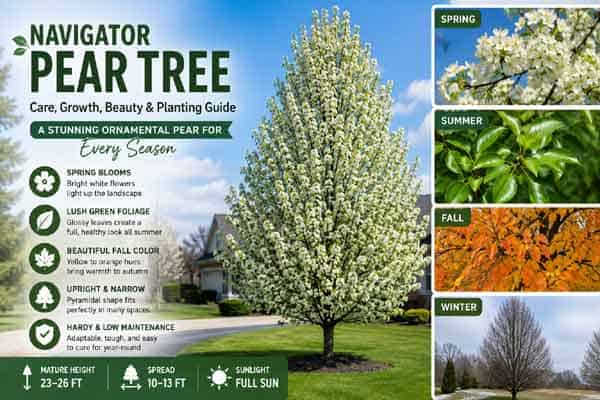
The Navigator Pear Tree is an interesting choice for homeowners who want a narrow, upright ornamental tree with spring flowers, green summer foliage, and attractive fall color. It has a naturally neat shape, which makes it useful for gardens where a very wide-spreading tree would take up too much room.
Navigator Pear is generally sold as an ornamental pear rather than as a traditional fruit tree. One commonly listed botanical name is Pyrus × ‘DurPSN303’. Nursery information describes it as a dense, pyramidal tree with white spring flowers and green foliage that changes color in autumn.
But is Navigator Pear suitable for your garden? How large will it become? Does it produce edible pears? And how much maintenance does it actually need?
Let’s look at each point before you decide to plant one.
Table of Contents
What Is a Navigator Pear Tree?
Navigator Pear is a deciduous ornamental pear tree grown mainly for its landscape appearance.
It develops an upright or pyramidal form rather than the broad, open shape commonly associated with many fruiting pear trees. Its dense branching gives the tree a relatively tidy appearance, making it useful as a focal point, entrance tree, or vertical accent in a landscape.
The tree is commonly listed as Pyrus × ‘DurPSN303’. Some nursery listings describe it as an extremely hardy ornamental pear with white flowers appearing in early to mid-spring.
During the growing season, the leaves provide a fresh green appearance. As autumn approaches, the foliage can develop yellow, orange, or reddish tones depending on growing conditions and climate.
One reason gardeners consider Navigator Pear is its combination of height, narrow spread, flowers, foliage, and seasonal color. Instead of providing just one attractive feature, it can contribute something different throughout the year.
Is Navigator Pear a Fruit Tree or Ornamental Tree?
This is one of the most common questions about Navigator Pear.
Although it belongs to the pear group, **Navigator Pear is primarily used as an ornamental landscape tree**. Its main value is its shape, flowers, foliage, and seasonal appearance rather than the production of large, sweet pears for eating.
That makes it very different from familiar fruiting varieties such as Bartlett, Bosc, or Anjou.
A fruiting pear is selected and managed primarily for its harvest. Navigator Pear is generally selected for landscaping.
Does that mean it never produces fruit?
Not necessarily.
Ornamental pears can sometimes produce small fruit, particularly under suitable pollination conditions. However, you should not buy a Navigator Pear expecting a dependable crop of supermarket-quality pears.
If your main goal is to grow pears for eating, a **dedicated fruiting pear cultivar** is a better choice.
If your priority is spring flowers, an upright shape, attractive foliage, and landscape value, Navigator Pear makes more sense.
How Big Does Navigator Pear Get?
Tree size is important to consider before planting because a young tree can look surprisingly small at the nursery.
Navigator Pear is not a dwarf tree.
One nursery listing gives an approximate mature height of 7–8 meters (23–26 feet) and a spread of 3–4 meters (10–13 feet). Another tree listing also identifies Navigator as a medium-sized ornamental tree.
Actual growth can vary depending on climate, soil, water availability, sunlight, and general tree health.
Why mature size matters?
Before planting, think about the tree’s size 10 or more years from now rather than its size on planting day.
Avoid placing it too close to:
* House walls
* Roofs
* Utility lines
* Driveways
* Small paths
* Fences
* Other mature trees
Its relatively narrow form can make it suitable for tighter landscapes, but “narrow” does not mean “tiny.”
Give the tree enough room to develop naturally.
How Fast Does Navigator Pear Grow?
Navigator Pear is generally described as a fast-growing ornamental tree, although the actual growth rate depends heavily on its environment.
A young tree planted in deep, fertile soil with adequate moisture and plenty of sunlight can establish much faster than one growing in compacted, dry, or poorly drained soil.
The first year or two are especially important. The tree is establishing its root system, so good watering and proper planting can have a major effect on later growth.
Rather than trying to force rapid growth with excessive fertilizer, concentrate on:
* Good soil preparation
* Consistent watering
* Adequate sunlight
* Mulching
* Correct planting depth
* Removing damaged branches when necessary
Healthy, steady growth is preferable to weak growth caused by excessive feeding.
Navigator Pear Flowers and Fall Color
One of the biggest attractions of Navigator Pear is its seasonal appearance.
Spring flowers
Navigator Pear produces bright white flowers in early to mid-spring according to nursery descriptions.
When the tree is covered with flowers, it can become an attractive focal point in a garden. The flowering period also gives the tree value before its summer foliage becomes the main feature.
Summer foliage
After flowering, the tree develops green foliage that provides a clean background for other plants.
Its glossy leaves and dense growth can help the tree maintain a full appearance through the warmer months.
Fall color
As temperatures change in autumn, the green foliage can shift toward yellow, orange, or reddish tones.
The exact color is not guaranteed to be identical every year. Weather, temperature, sunlight, and the tree’s growing conditions can all affect fall foliage.
This seasonal change is one reason ornamental pears are often planted as landscape specimens rather than simply as flowering trees.
Best Location for Planting
Choosing the right location can make a bigger difference than adding fertilizer later.
Navigator Pear generally performs best when planted in an open area where it has access to sunlight and enough room for its mature crown.
Choose a location with:
* Good sunlight
* Well-drained soil
* Enough room for mature branches
* Protection from severe site problems
* Easy access to water during establishment
Avoid planting directly beside a building simply because the young tree looks small.
Think about the mature height and spread before digging the hole.
Can it be planted near a sidewalk?
It may be suitable for some streetside or narrow landscape situations because of its relatively upright form. However, the exact distance should depend on local conditions, mature dimensions, nearby structures, and utility infrastructure.
When in doubt, give the tree more room rather than less.
Soil Requirements
Navigator Pear prefers moist, well-drained soil. One nursery source also notes a preference for soil with a higher pH.
The most important thing is avoiding a planting location where water remains around the roots for long periods.
Good soil conditions include:
* Reasonable drainage
* Adequate organic matter
* Enough depth for root development
* Consistent moisture without waterlogging
If your garden soil is heavy clay, improve the planting area carefully rather than creating a small pocket of dramatically different soil.
A thick layer of mulch around the tree can also help retain moisture and moderate soil temperature.
Keep mulch away from direct contact with the trunk.
How Much Sun Does It Need?
Navigator Pear performs best in a sunny location.
Good sunlight helps support:
* Strong growth
* Better flowering
* Healthy foliage
* A fuller crown
* Good seasonal color
A location receiving several hours of direct sunlight is generally preferable to a heavily shaded corner.
If the tree receives too little light, it may develop weaker or less attractive growth and produce fewer flowers.
When planning your garden, also consider how nearby buildings and mature trees may change the amount of sunlight the Navigator Pear receives as the years pass.
How Often Should You Water It?
Watering needs will vary with the age of the tree, climate, soil type, rainfall and season.
A newly planted Navigator Pear needs more attention than an established tree because its root system is still developing.
During establishment
Water deeply when the soil begins to dry rather than giving the tree a small amount of water every day.
The goal is to encourage the roots to grow into the surrounding soil.
During hot and dry weather, check the soil more frequently.
After establishment
An established tree usually needs less frequent irrigation, especially when natural rainfall is adequate.
However, prolonged drought can still stress the tree.
Watch for signs such as:
* Drooping leaves
* Premature leaf drop
* Dry soil
* Reduced new growth
Avoid keeping the soil constantly saturated. Too much water can be just as problematic as too little.
How to Prune Navigator Pear?
Navigator Pear naturally develops an upright and relatively neat form, so heavy pruning should not normally be necessary simply to make it look attractive.
Pruning is mainly useful for removing unhealthy growth and maintaining a strong structure.
Remove:
* Dead branches
* Broken branches
* Diseased wood
* Branches that cross badly
* Weak or poorly positioned shoots
Young trees can benefit from structural pruning when needed.
Do not remove large amounts of healthy growth every year just because you want to keep the tree small. Choosing the correct planting location is a better long-term solution.
If a mature tree has developed a major structural problem, professional advice may be worthwhile before making large cuts.
Common Problems and Diseases
Like other ornamental trees, Navigator Pear can experience problems caused by insects, diseases, weather, poor soil, or improper care.
Potential problems can include:
* Leaf spots
* Fungal diseases
* Fire blight in susceptible conditions
* Insect pests
* Drought stress
* Root problems caused by poor drainage
* Branch damage from storms
Not every Navigator Pear will experience these issues.
How to reduce problems?
Do not automatically treat every discoloration with a pesticide or fungicide. First identify what is causing the problem.
If branches suddenly die, leaves show serious disease symptoms, or the trunk develops significant damage, contact a local arborist or horticultural professional for a proper diagnosis.
Does Navigator Pear Produce Fruit?
Navigator Pear is primarily an ornamental tree, so **fruit production should not be the main reason for planting it**.
Some ornamental pear trees can produce small fruits, while fruiting can vary depending on pollination and environmental conditions.
The important distinction is that any fruit should not automatically be considered equivalent to the large, sweet pears produced by dedicated fruit varieties.
If you want a tree specifically for harvesting pears, choose a cultivar recommended for edible fruit production in your climate.
If you want an attractive landscape tree with flowers and seasonal foliage, Navigator Pear is a different proposition.
Is Navigator Pear Good for a Small Yard?
It can be a useful option for a smaller or narrower landscape, particularly because its growth habit is more upright than many broad-canopy trees.
However, it should not be treated as a tiny tree.
With nursery estimates around 23–26 feet tall and 10–13 feet wide, you still need to plan for its mature dimensions.
It may work well for:
* Front-yard planting
* Narrow lawn areas
* Long garden borders
* Entryways
* Larger containers of landscape space
* Urban-style landscapes where vertical growth is useful
For a very small courtyard, roof garden, or tiny backyard, a genuinely dwarf tree may be more appropriate.
Navigator Pear vs. Fruiting Pear
The biggest difference is purpose.
| Feature | Navigator Pear | Fruiting Pear |
| Main purpose | Ornamental landscaping | Fruit production |
| Flowers | Attractive spring display | Usually attractive spring flowers |
| Fruit | Not the main feature | Main reason for growing |
| Shape | Upright/pyramidal | Depends on cultivar |
| Fall interest | Often attractive | Depends on variety |
| Maintenance | Mainly landscape care | Often requires fruit-tree management |
| Best for | Decorative landscape | Home fruit harvest |
If you want a tree that looks good in several seasons, Navigator Pear may be worth considering.
If you want pears for eating, choose a fruiting cultivar instead.
The two should not be judged by exactly the same standards.
Pros and Cons of Planting Navigator Pear
Before buying a tree, it helps to consider both sides.
Pros
* Attractive white spring flowers
* Upright, pyramidal growth habit
* Glossy green summer foliage
* Interesting autumn color
* Useful as a landscape specimen
* Can suit narrower planting spaces better than broad trees
* Provides several seasons of visual interest
Cons
* It can become a medium-sized tree
* Not the best choice if your main goal is edible fruit
* Mature size needs to be considered before planting
* Young trees need consistent watering while establishing
* Ornamental pear types can have disease or pest issues
* Suitability of ornamental pear types can vary by region
There is also an important regional consideration: some ornamental pear types, particularly certain Callery pear relatives, are considered invasive or restricted in parts of North America. Before planting, check local recommendations and regulations rather than assuming that a tree sold at a nursery is suitable everywhere.
FAQ about Navigator pear tree
Q.1 How tall does Navigator Pear become?
Ans. A commonly listed mature size is approximately 23–26 feet tall, with a spread of around 10–13 feet. Actual size can vary according to growing conditions.
Q.2 Does Navigator Pear produce edible pears?
Ans. Navigator Pear should not be purchased as a conventional fruit-producing pear. Its primary value is ornamental. Some trees may produce small fruit, but it is not generally grown for a dependable edible crop.
Q.3 Can Navigator Pear grow in a small garden?
Ans. It can work in a relatively narrow landscape because of its upright form, but it can still reach more than 20 feet in height. Always plan for the mature size.
Q.4 How often should I prune Navigator Pear?
Ans. Routine heavy pruning is usually unnecessary. The objective is to remove dead, damaged, diseased, crossing or poorly placed branches and to maintain a strong structure.
Q.5 Is Navigator Pear the same as a regular pear tree?
Ans. Nope. Navigator Pear is used primarily as an ornamental landscape tree, whereas traditional fruiting pear cultivars are grown primarily for edible fruit.
Follow – https://sggreek.com for More Updates
