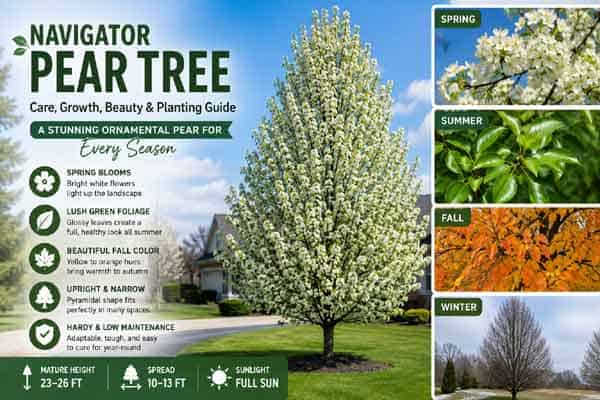
If you stumbled upon the term “Navigator pear” you might be wondering if it is a fruit tree, an ornamental tree or something else altogether. The answer is a little more interesting than it might seem at first. Navigator pear is primarily used as a “landscape tree” for its upright form, white spring flowers, glossy green foliage and attractive fall color.
The tree is commonly listed as “Pyrus × ‘DurPSN303”. References from nurseries and municipal landscapes describe it as a hardy ornamental pear with a rather narrow pyramidal growth habit. One nursery listing gives a mature height of approximately 23–26 feet (7–8 meters) and a spread of approximately 10–13 feet (3–4 meters). A landscape reference from Edmonton lists the tree at approximately 5 meters showing how mature dimensions can differ with climate, growing conditions and the source’s measurement standards.
Another interesting reason for people to find the word “pear” online is: Searches like “navigate to Twisted Pear Forest City” and “navigate Twisted Pear Forest City NC Facebook” aren’t referring to a tree, but rather a local business in Forest City, North Carolina. The two topics are unrelated but both can show up in searches that include the word “pear.”
First off let’s take a look at the Navigator tree and then talk about the Forest City connection.
Table of Contents
What’s a Navigator Pear?
Pyrus × ‘DurPSN303’, an ornamental pear cultivar known as Navigator pear. Landscape qualities, rather than edible fruit, are also the reason for selecting traditional European or Asian pear trees.
Its attraction is the presence of several attractive features at various times of the year:
- White flowers in the spring
- Glossy green summer leaves.
- Orange-yellow fall colors
- Dense upright or pyramid shape
- Comparatively narrow width than many large shade trees
Good suitability for formal landscape designs
A good way to think about it is this: a traditional fruit pear is often planted because the owner wants to eat pears, while a Navigator ornamental pear is planted because the tree itself adds structure and seasonal color to the garden.
Navigator is specifically described as a pyramidal ornamental tree with dense foliage that produces bright white flowers in early to mid-spring. It also states that the dark green glossy foliage turns orange-yellow in the fall.
Navigator Pear Tree Size and Growth Habit
One of the most important things to consider before planting a Navigator pear tree is its ultimate size.
A young nursery tree may look surprisingly small when you bring it home. A tree 5 or 6 feet tall may be just the thing for a narrow part of the garden. But that tree has a lot of growing to go.
Navigator dimensions are available in different sizes. One nursery source says:
Height:** ca. 23-26 ft
Range:** 10 to 13 feet
Another landscaping reference notes the mature height of navigator pear as approximately 5 m.
Please note these numbers are practical estimates and not a guaranty. Soil, sunlight, water availability, climate, pruning and the age of the tree can affect the final size.
What homeowners need to know is that Navigator is not a small patio tree. Make room from the beginning.
If you are planting it near a driveway, walkway, house, fence or overhead utility line, consider the tree’s mature size, not its size on planting day.
Why is the Navigator Ornamental Pear so popular?
When you get the idea of what the tree is supposed to give, the term navigator ornamental pear makes sense.
Spring: White Blossoms
This tree is most conspicuous in the spring.
Navigator produces clusters of white flowers when many gardens are waking from winter. The flowers give a bright clean look contrasted against the darker branches and early season greenery.
The time of flowering may depend on the local climate. Warmer areas may get earlier blooms, while colder areas may have a later spring display.
Summer: Bright Green Leaves
After flowering, the tree takes on a summer green appearance.
It’s glossy leaves help keep the tree looking neat during the growing season. The thick canopy can also serve as a visual screen, but should not be relied on as a substitute for a dedicated privacy hedge.
Fall: Yellow-Orange
Another big reason folks go with Navigator is the move into autumn.
Its foliage is green and can become yellow-orange in fall. Some nursery references refer to the seasonal color as orange-yellow while others use stronger red or orange descriptions. Actual color may vary with weather, sunlight and local growing conditions.
The seasonal change makes this tree more valuable than a plant that is attractive for only a few weeks.
Does Pear Tree Fruit Navigator?
Here, expectations are important.
Navigator is an ornamental pear and not a tree selected primarily for producing large, sweet pears for the kitchen.
Some references refer to the tree as producing small and relatively sparse fruit. For example, a historical plant guide says Navigator is a hardy ornamental tree, with small fruit that is not abundant.
Therefore, if you want to grow pears primarily for eating, Navigator is probably not the first tree you should consider.
But if you want a flowering ornamental tree with seasonal foliage, then its properties make a lot more sense.
Location of a Navigator Pear Tree?
The site you choose for any ornamentals can greatly affect how well they perform over the long term.
Full Sun is Best
Navigator needs lots of direct sun to do best. A sunny spot promotes more vigorous growth and helps the tree reach its potential for flowering and foliage.
For a practical goal aim for 6-8 hours of direct sunlight per day where possible.
A location with only a couple of hours of weak sunlight may not perform as well as an open position.
Give It Space Enough
Don’t judge spacing on the nursery container.
Obviously, if the mature spread is going to be 10 to 13 feet, planting the tree only 3 feet from a wall is going to create problems later.
Clear the space for:
- Development of Branch
- Growth of the root
- Servicing access
- Mowing
- Air movement
- Cut back future
A little extra space today can save you a lot of frustration five or ten years from now.
What is Soil Needs for Navigator Pear?
Navigator pear is usually described as liking ** moist, well-drained soil ** . Some nursery information specifies higher pH conditions .
This doesn’t mean you should keep the soil wet all the time.
Moist soil is not the same as waterlogged soil and there’s a big difference.
A simple test is to dig a planting hole, fill it with water and see how quickly the water drains. Drainage improvement may be necessary before planting of long-standing water.
Organic matter improves soil structure especially on poor or compacted ground.
Watering Young Navigator Pears
Newly planted trees require more care than established trees.
Check the soil rather than watering according to a rigid calendar during the first growing season.
A practical approach would be:
1. Test the soil to a depth of several inches.
2. Water well as the soil begins to dry.
3. Let excess water drain off.
4. Don’t keep the root zone wet all the time.
The watering schedule for newly planted trees may be more frequent in hot weather compared to mild spring weather.
Once established, the tree should become less dependent on frequent watering, although extended periods of drought can still stress it.
Mulching: A Simple Step That Helps
One of the easiest improvements a homeowner can make around a young tree is mulch.
Put about 2 to 3 inches of organic mulch around the root zone, but keep the mulch away from touching the trunk.
Don’t create the classic “mulch volcano” on the trunk.
Create a broad, shallow ring of mulch. This reduces competition from grass, slows evaporation and moderates soil temperature.
Pruning the Navigator Pear
Pruning is particularly useful when the tree is young.
It is not about keeping the tree trimmed into an artificial shape. Focus on building a good structure instead.”
When you feel you have done enough, you should stop. That’s all.
- Dead twigs
- Broken twigs
- Branch crossing
- Poorly attached shoots
- Branches that create obvious structural issues
As a rule, major structural pruning is easier when the tree is young because the branches are smaller and easier to handle.
Don’t take off large amounts of healthy growth at one time unless you have a reason to do so.
If a mature tree develops a serious structural problem, it can be safer to hire a qualified arborist than to attempt major pruning from a ladder.
Common Landscape Applications
The Navigator pear can be especially good for the homeowner who wants a tree that grows upward rather than making an extremely broad canopy.
Potential applications include:
- Front-yard specimen planting
- Residential streetscapes
- Driveway Approaches
- Gardens, formal
- Business scenery
- plantings along boulevards
- Smaller landscape sites
Its relatively narrow reported spread can be attractive for places where a very wide shade tree would become inconvenient.
But “narrow” doesn’t mean you can plant anywhere. Always consider mature dimensions.
Is Navigator Pear Suitable for All Gardens?
Not necessarily.
What the right tree is depends very much on your location and what you want from it.
Navigator may be a good fit if you want:
- Flowers in spring
- Fall color, seasonal
- A landscape tree vertical
- A pretty controlled width of canopy
- More of decorative merit than substance to eat fruit .
If your priority is: You might consider alternatives:
- Large edible pears
- Value to native wildlife
- Very small when mature
- A tree suited to your local ecosystem.
There is also a more general problem with ornamental pears: different cultivars, and related types of pears, can have different ecological and structural characteristics. Before planting any ornamental pear, consult recommendations from your local extension service or municipal planting guide.
Navigator Pear vs. Regular Fruit Pear
The difference is more understandable with a simple comparison.
Hence why you sometimes get confused when you search for “pear.” The word does not necessarily mean that a certain pear tree is intended for fruit production.
What does Navigate to Twisted Pear Forest City mean?
Now we get to the weird part of these search terms.
If you searched navigate to Twisted Pear Forest City you are probably looking for a business, not a plant.
Twisted Pear Taproom & Coffee is a local business in Forest City, North Carolina. The town’s official tourism website features Twisted Pear as one of Forest City’s local food and drink destinations.
Current business information shows the business location as 149 W Trade St, Forest City, NC 28043 while some older online listings and historical documents list 184 E Main Street. This difference matters if you’re navigating from an old article or a directory listing.
So if your search is specifically about visiting the business, use a current map listing instead of an old address copied from a blog.
Directions to Twisted Pear Forest City
If you don’t know Forest City, the easiest thing to do is to search the business by its full name:
Twisted Pear Taproom & Coffee, Forest City, North Carolina
A map app can then give you directions from your starting point.
The business is part of a larger collection of local shops and eateries associated with Forest City’s downtown area. Forest City’s tourism organization calls the town home to independently owned restaurants, bars, bakeries and coffee shops.
This also explains why searches for “Forest City” and “Twisted Pear” might show up next to unrelated searches about Navigator pear trees.
The Truth About “Navigate Twisted Pear Forest City NC Facebook”
Another example of a search query with local intent is the phrase **navigate twisted pear forest city nc Facebook**.
Someone typing this phrase may be looking for the business’s social-media presence, location, events or current information.
That’s particularly understandable for a local venue, since business details may change over time. A business is more likely to update its current listings or social channels with hours, events, menus and locations, than an old article.
As of October 2023, third-party listings for Twisted Pear include a taproom and coffee house, and reviews and business information are available online.
If you are planning a visit, check the current location and opening hours before leaving, especially if you use an older search result.
Common Questions about it
Q.1 What colors are the leaves in the fall?
Ans. The foliage of the navigator is generally described as turning from green to yellow-orange in the fall.
Q.2 Can I grow Navigator pear in a small garden?
Ans. It can work in a relatively constrained landscape compared to much wider trees but remember it can still reach roughly 23-26 feet tall with a 10-13 foot spread according to one nursery listing. Measure the planting location before purchasing.
Q.3 Is the Navigator pear tree the same as Twisted Pear in Forest City?
Naw. The names are just the same. Navigator pear is a tree cultivar Twisted Pear is a local business in Forest City, North Carolina.
Q.4 Where is Twisted Pear located in Forest City?
Today, structured business information lists Twisted Pear Taproom & Coffee as operating at **149 W Trade St, Forest City, NC 28043. Older sources have it as 184 E Main Street, so check the current business listing before heading over.
Conclusion
Navigator pear tree This fruit tree is an interesting choice for homeowners who want more than just greenery. It has some seasons of visual interest, with white spring flowers, glossy summer foliage, upright growth and yellow-orange autumn color.
The published numbers also tell a significant story. A tree of this size, at about 23-26 feet tall and 10-13 feet wide, is large enough to be a major element in a residential landscape and some thought should be given to where it might be planted.
At the same time, don’t confuse Navigator with a regular orchard pear.” It is primarily a ornamental pear. Its fruit is small and fairly sparse and not the main reason to grow it.
For the tree, pay attention to sunlight, drainage, mature size and structural pruning. Hours and location for Forest City business, check current local listings. That little difference can save you from buying the wrong tree — or going to the wrong “pear.”
Follow – https://sggreek.com
